Friday, December 3, 2010

Pediatric Intranasal Fentanyl

Scenario
It's a summer afternoon and you're dispatched to a 9 year old male patient involved in an ATV accident. The nearest ALS engine company has been dispatched as well. Upon your arrival you find an ATV on its side, another ATV upright, and a crowd gathered on the porch of a nearby house. A paramedic from the engine is assessing a distraught young boy, sitting in his mother's lap, holding an obviously deformed right forearm. The officer on the engine informs you that the boy and his father were riding alongside the road, traveling at 20-30 miles per hour, when the boy lost control and was thrown from the ATV (his father insists he was wearing his helmet).

You introduce yourself to the child, assuring him you're here to help, and ask him what happened. The boy states that when he fell he put his arms out and he heard a loud pop when his right hand hit the ground. He denies passing out or any other injuries but says his arm, "really hurts". He reluctantly allows you to assess his radial pulse in the affected arm, which is rapid but easily palpable. There appears to be distal involvement of both the radius and ulna, however he does not tolerate any further assessment of the arm and screams if there is any movement. The remainder of your physical exam reveals only minor abrasions to exposed skin. The engine company reports tachypnea, tachycardia, and a normal blood pressure.

Discussion
It appears the child has suffered a Colles' Fracture of the right distal forearm. Appropriate treatment would include splinting, ice packs, and pharmacologic pain control. However, given the current state of the patient, it may not be possible to splint the extremity due to anxiety and pain. Traditional prehospital pain management would require intravenous access or intramuscular administration. Both of these routes are likely to cause increased anxiety in this patient, which is best avoided.

Pain management in the pre-hospital setting is fraught with problems. Most studies have found poor provider perception of pain, underutilization of analgesics, and a hesitance to treat pediatric pain (Thomas; Greenwald). Often times, studies find that even if patients are provided analgesia, they do not feel their pain was managed adequately at all (Thomas). For pediatric patients, this problem is compounded as pre-hospital providers are often wary to provide pain management or may be unable to obtain invasive IV access to provide pain management (Greenwald). Moreover, pre-hospital providers are often placed in situations where access to patients is limited to provide pain-management, often times resulting in painful patient movements.

The addition of a noninvasive means of pain management would be an invaluable aid to pre-hospital providers and would remove a potential barrier to care. In pediatric populations, the importance of noninvasive pain management procedures is easy to grasp, as this patient population is often unable to comprehend the benefits of initially painful procedures. Improvements in "time to analgesia" will likely lead to and have a direct, positive impact on patient care and satisfaction.

Efficacy and Safety of Intranasal Fentanyl
The efficacy and safety of intranasal fentanyl (INF) has been the focus of multiple studies, both in-hospital and pre-hospital. Finn et al conducted an in-hospital randomized double-blind placebo controlled trial and found INF to have the same efficacy as oral morphine during procedural wound care in adult burn patients (n=26, 35.5 ± 12.4 years). The concentration of INF used in this study was 50 µg/mL, initial dosages of 1.48 ± 0.57 µg/kg, and no difference in the number of adverse events. Finn et al concluded that while patients receiving INF were more satisfied with their level of pain relief (p = 0.009) that overall only half of the patients in the trial reported they were "satisfied" or "very satisfied".

In a randomized, controlled, open-label study of pre-hospital INF versus IV morphine, Rickard et al found no significant difference in efficacy or safety (n=258, 42.3 ± 13.7 years). This study differs from Finn et al in that there were a multitude of chief complaints treated due to an "all-comers" design. Moreover, the doses used of INF was significantly higher at 180 µg divided evenly between the nares with up to two repeat dosages of 60 µg. Patients in the INF group received pain medication earlier than in the IV morphine group, likely owing to the simpler route of administration. Adverse effects were noted to occur more frequently in the INF group (relative risk 2.09, 95% CI 0.92-4.78, p = 0.07), however, the Rickard et al was not powered to adequately detect any statistical difference. One incidence of a significant adverse effect required a termination of the INF protocol, but it was unclear from the study if this was related to the treatment or the patient's condition. Rickard et al concluded that given the safety and efficacy of INF, it is a valuable option in patients where intravenous access is "undesirable or impossible".

Borland et al 2005 and Borland et al 2007 were inpatient randomized double-blind crossover studies evaluating the efficacy and safety of INF versus oral or IV morphine, respectively, in pediatric patients. Borland et al 2005 studied INF in pediatric burn patients requiring daily dressing changes and found no significant difference in outcomes (n=24, median 4.5 IQR 1.8-9.0 years). The INF dosage was calculated against the bioavailability of the IN route (listed as 70%) with 1.4 µg/kg fentanyl equating to an IV dosage of 1 µg/kg. There were no incidents of significant adverse events, although this was likely due to the study size. However, sedation scores recorded found that INF patients recovered earlier than their oral morphine counterparts. Overall, Borland et al 2005 found INF to be safe and efficacious, but more importantly well tolerated by pediatric patients.

Borland et al 2007 found INF to be comparable to intravenous morphine in pediatric patients presenting to the emergency department with acute long-bone fractures (n=67, 10.9 ± 2.4 years). The median total dose was 1.7 µg/kg fentanyl with repeat doses given PRN. The impetus of the study was to find alternative methods of analgesia to intravenous narcotics in the pediatric population. The study authors note that given the comparable efficacy, INF is invaluable as a means to decrease "time to analgesia" in the pediatric population with potential for pre-hospital adoption.

Mudd conducted a systematic review of the available literature for INF in the pediatric population and graded 12 studies with evidence qualities of four Level I/A, one II/A, two II/B, one III/A, and four at III/B. There was a wide variation in dosing of INF amongst the studies, with a common range of 1-2 µg/kg fentanyl. Differences in concentrations existed as well, owing to the fact that in the US fentanyl is commonly available at 50 µg/mL and is used IV/IM/IO/IN yet overseas it is often given IN with a more concentrated 100-150 µg/mL solution. No differences in significance in pain reduction were found between concentrations, only in the volume of medication delivered. While no studies found a significant difference in adverse effects, many studies had small sample sizes and no long-term studies have been completed on the action of fentanyl on the nasal mucosa. However, the evidence in the reviewed studies demonstrated three clear points: (1) that INF is as efficacious as IV/IM/PO morphine or IV fentanyl, (2) it has no difference in adverse effects, and (3) it decreases the time to analgesia administration and pain relief.

Intranasal Fentanyl Protocol
Based on the research available and the existing 2009 NC EMS protocols, an appropriate pain management protocol for the administration of intranasal fentanyl is given below:
  • Adult patients with indications for narcotic analgesia for whom intravenous access is not feasible, not available, or at the discretion of the lead Paramedic, an initial dose of 50-75 µg fentanyl may be delivered intranasally. The total volume to be administered should be divided equally between the two nares (not to exceed 1mL per nare).
    • If intravenous access is not available, repeat with 25 µg fentanyl delivered intranasally every 20 minutes to a maximum total dose of 200 µg.
  • Pediatric patients with indications for narcotic analgesia an initial dose of 1-2 µg/kg fentanyl up to a total dose of 50 µg may be delivered intranasally. The total volume to be administered should be divided equally between the two nares (not to exceed 0.5mL per nare).
    • In order to decrease the anxiety of pediatric patients requiring analgesia and invasive procedures (such as intravenous access), it may be prudent to begin with intranasal fentanyl.
References
  • M. Borland, I. Jacobs and I. Rogers, Options in prehospital analgesia, Emerg Med (Freemantle) 14 (2002), pp. 77–84.
  • M. Borland, I. Jacobs and G. Geelhoed, Intranasal fentanyl reduces acute pain in children in the emergency department: a safety and efficacy study, Emerg Med (Freemantle) 14 (2002), pp. 275–280.
  • J. Finn, J. Wright, J. Fong, E. Mackenzie, F. Wood, G. Leslie and A. Gelavis, A randomized crossover trial of patient controlled intranasal fentanyl and oral morphine for procedural wound care in adult patients with burns, Burns 30 (3) (2004), pp. 262–268.
  • M. Borland, R. Bergesio and E.M. Pascoe et al., Intranasal fentanyl is an equivalent analgesic to oral morphine in paediatric burns patients for dressing changes: a randomised double blind crossover study, Burns 31 (2005), pp. 831–837.
  • M. Borland, I. Jacob and B. King et al., A randomized controlled trial comparing intranasal fentanyl to intravenous morphine for managing acute pain in the emergency department, Ann Emerg Med 49 (2007), pp. 335–340.
  • C. Rickard, P. O’Meara, M. McGrail, et al., A randomized controlled trial of intranasal fentanyl vs intravenous morphine for analgesia in the prehospital setting, Amer J Emerg Med 25 (2007), pp. 911-917.
  • S. Thomas, S. Shewakramani, Prehospital Trauma Analgesia, J Emerg Med 35 (2007), pp. 47-57.
  • M. Greenwald, Analgesia for the Pediatric Trauma Patient: Primum Non Nocere? Clin Pedi Emerg Med 11 (2010), pp. 28-40.
  • S. Mudd, Intranasal Fentanyl for Pain Management in Pediatrics: A Review of the Literature, J Pedi Health Care (2010), Article in Press. doi:10.1016/j.pedhc.2010.04.011.

Friday, October 22, 2010

One Year: Thank You

One year has passed since I received my EMT-Paramedic, and I'd like to say thank you.

Firstly, to my friends and family. You have endured my absence well, or at least have hid your anger well. I'm sure this last year has been tough, but probably not as tough as paramedic school. I really could not do this job without your support, especially as a volunteer. I cannot say it enough, thank you.

To my colleagues and peers, you have surely challenged me to accomplish things I never knew I was capable of doing. You have mentored me, scolded me, and sat patiently while I fumbled with IVs. There is an entire network of you online which have been invaluable as a sounding board and a reference. I can only hope I will continue to take what you have given me and make myself a better Paramedic going forward. The fact that I feel like my feet are underneath me at all is a testament to you all, thank you.

Lastly, to my patients of whom I've met quite a few: you have taught me more than I could ever hope to tell you. Some of you were thrust into my arms, others I knelt and said goodbye. You have challenged me to better myself and I appreciate every experience. My life as a green Paramedic has been an odd mix of on-the-job training for emergencies I was never told about and connecting the dots for those I was told every day about. I thank you for your understanding. I hope that I can tell a story of that time I sat next to you on a flight, and heard about your trip to see your niece get married. That is why I am here, you are why I am here. I feel blessed to meet each and every one of you, thank you.

Monday, October 18, 2010

2010 AHA CPR/ECC Guidelines

If you haven't already heard, today the AHA released the 2010 edition of their CPR/ECC Guidelines which include updates for laypersons, BLS, ACLS, PALS, and neonatal resuscitation. If you've been following resuscitation research at all for the last few years, there are not many surprises.

  1. Compressions trump ventilations in adult patients (C-A-B not A-B-C).
  2. Minimize interruptions in the "flow" of a resuscitation, that is, continuous compressions are to be minimally interrupted.
  3. ETCO2 is to be preferred over manual pulse checks: if you don't have a rise in ETCO2 to physiologic or near-physiologic levels, you probably do not have a perfusing rhythm.
  4. AEDs are indicated for all ages, including infants and neonates, provided there are pads available which fit without overlap (>3cm gap).
  5. Pharmacologic therapy has the same weight as TCP in certain bradyarrhythmias.
  6. Procainamide is now first-line or at least recommended on par with Amiodarone, Lidocaine is almost off the list.
  7. Atropine is no longer recommended during routine PEA/Asystole resuscitations.
  8. Studies into neonatal resuscitation have shown that deep suctioning is not required in vigorously born neonates with meconium staining.
  9. Routine use of naloxone in cardiac arrest secondary to opioid overdose is not recommended.
There were many other differences, including the addition of circular flowcharts documenting the new guidelines (linear flowcharts are still provided). I encourage everyone to read them.

Edit: here is a document (PDF) comparing the AHA 2005 CPR/ECC guidelines to the 2010 guidelines.

Monday, September 13, 2010

How many Automated External Defibrillators are at your place of work?

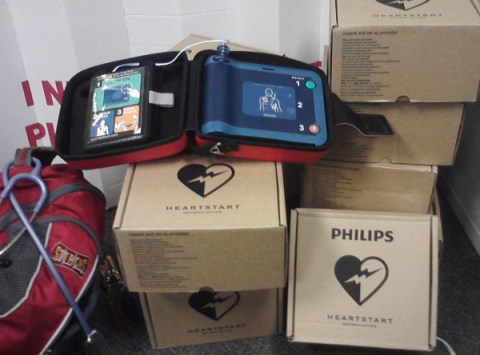
Our Industrial Fire Brigade just added 10 more AEDs to our site. By my rough calculations this means we have 1 AED for every 150 employees and 1 AED for every 80,000 sqft of floor space (we have almost 2 million sqft). To put this in perspective, the recommendations generally are for 1 AED per 100,000-150,000 sqft or building floor. We now have an AED and emergency responders within 2 minutes of every employee on site!

The Philips HeartStart FRx is a great first responder AED as this author has learned through personal experience.
How does your place of work stack up? Do you need help with corporate/management buy-in? Perhaps our site's successes can help you out. Let me know!

Tuesday, September 7, 2010

12-Lead ECG: What Is It?

While cleaning up my office to put in a reading chair, I found the following 12-Lead ECGs from my clinical time.  I apologize for the poor quality of the first one, but it is a copy of a copy (of probably a copy). I have limited information on the patients for each of them somewhere in my clinical binder, but I haven't found those yet.
ECG 1

ECG 2

What do these two 12-Leads show?

Do you agree with the computerized statements?

Update on ECG 1 (16 Sept 2010)


The patient's lab values include a K+ of 2.1 mEq/L. What are some of the expected ECG changes in hypokalemia? Does this ECG show a classical or atypical presentation of hypokalemia?

Monday, August 23, 2010

Pediatric Transcutaneous Pacing

Being out of school only recently, I'm often asked "book" questions which are likely to be fresh in my mind. One of these that had me stumped was simply, "what is the appropriate current settings for pediatric transcutaneous pacing?"

I had no answer.

Honestly I had no idea, but assumed it would be weight based, and along the lines of the PALS guidelines for defibrillation. However, when I researched this topic in my PALS book I found there were no answers for pediatric pacing [1]. In fact, there was little mention of TCP whatsoever! Going over to ACLS I found no answers for current settings in adults, just when it was indicated [2].

However, in Paramedic school we had been taught the appropriate current ranges for TCP in adults, which ranged from 20-200 mA. Zoll et al found that most adults responded to TCP in the range of 40-70 mA, however, some required currents up to the device maximum of 140 mA [3]. After a few hours of searching for guidelines specific to pediatrics (including the Philips, Physio-Control, and Zoll websites), I came across a study on TCP in pediatrics which focused on the current required for different electrode sizes. Much to my amazement, the current settings required for external transcutaneous pacing of pediatrics are the same as for an adult!
A total of 56 pacing trials were conducted, 53 of which were successful in obtaining capture. A mean output of 63 +/- 14 mA (range, 42-98) at threshold using the large electrodes was comparable to published adult requirements. Béland MJ et al [4]
How could this be, wouldn't a smaller heart need less energy?

It seemed paradoxical at first, but reviewing the anatomy and physiology of a myocyte with an emphasis on the physics aspect puts it into perspective [5]. Each myocyte in the heart is a part of what amounts to an big electromechanical pump. Given a sufficient input stimulus a myocyte contracts and forwards a stimulus to its neighbors, which follow suit, leading to the eventual coordination of systole and diastole.

The goal of any artificial cardiac pacemaker, whether internal or external, is to act as the primary input stimulus by applying a current to an area of the heart which exceeds the stimulation threshold, i.e. the current required to cause a response from the myocardium.

Therefore, transcutaneous cardiac pacemakers attempt to exceed the stimulation threshold of a single area. It would be hard to achieve coordinated ventricular activity if the current was too high, instead you would have defibrillation. It stands to reason that if the only threshold required to overcome is the stimulation threshold of a single area of the myocardium, the weight of the heart--generalized as the weight of the patient--would be irrelevant.

In contrast, the goal of defibrillation is to bring all electrical activity in the heart to a halt. Defibrillation is not successful unless the all of the reentrant activations of ventricular fibrillation are stopped. Therefore the therapeutic energy levels are going to be proportional to the amount of myocardium you are acting on. Hence, pediatric defibrillation energy dosages are weight based.

So what seemed counterintuitive at first, is actually fairly logical. Pediatric transcutaneous cardiac pacing has the same energy requirements as adults because myocardium has the same stimulation threshold regardless of age. This deduction is supported in the literature as well:
No correlation has been defined between transcutaneous pacing threshholds and age, body weight, body surface area, chest diameter, cardiac drug therapy, or etiology of underlying heart disease. [6]
So there we have it, transcutaneous cardiac pacing current setting ranges are universal amongst our patient population. Below is a guideline I've created as a supplement to the material contained within PALS:
Pediatric Transcutaneous Cardiac Pacing
Symptomatic bradycardia in the pediatric population is most often related to hypoxia secondary to respiratory etiologies. In rare situations it may exist in spite of adequate ventilation and oxygenation. Given the presence of a high degree heart blocks, or symptomatic bradycardia refractory to aggressive BLS and ALS treatments, transcutaneous cardiac pacing should be initiated without delay.

Indications
  • High degree heart blocks
  • Symptomatic bradycardia refractory to ventilation, oxygenation, chest compressions, and pharmacological treatments

Contraindications
The only contraindication of TCP is an inability to place the pads on the patient without overlap or sufficient distance between them.

Side Effects
The side effects of TCP are most frequently muscle activation and associated pain. These are dose dependent effects which are a combination of the current delivered, size of the pads, location of the pads, and width (time) of the delivered pulse [7].

To minimize these side effects use the largest available pads, placing them in an Apical-Posterior fashion. While larger pads require higher current outputs, there is a decrease in the current delivered per surface area reducing the side effects associated with TCP.

Often, management of these side effects is achieved through concurrent pharmacological treatment with analgesics and/or sedatives.

Dose
Pediatric transcutaneous cardiac pacing (TCP) is defined by two dosing parameters: output current and rate. This guideline assumes the pacemaker is in fixed mode.

Output Current
As with adult patients, the output current for pediatric transcutaneous cardiac pacing should begin at 20 mA (or the lowest setting available) and increase in 5-10 mA increments until electromechanical capture is obtained. Additionally, the current may be increased an additional 5-10 mA above the determined threshold to ensure continued capture. If the device maximum output current is reached and no electromechanical capture exists, discontinue TCP and troubleshoot. Attempt an alternative pad placement (anterio-apical or anterior-posterior) and ensure the negative pad is on the anterior aspect of the chest. If capture is still not obtained, resume CPR and obtain expert consultation.

Output Rate
In contrast to adult patients, the output rate for pediatric transcutaneous cardiac pacing is age based. The final output rate should be titrated to an adequate systolic blood pressure to resolve perfusion problems, e.g. an improvement in mental status. Care should be taken to avoid tachycardic rates or hypertension. Consult a length-based resuscitation tape (e.g. Broselow™ tape) for appropriate starting output rates and systolic blood pressure. An example table is given below, adapted from the North Carolina 2009 EMS Standards [8]:

AgeRate (bpm)Systolic BP (mmHg)
0-3 mo120-15085 (+/-25)
3-6 mo120-13090 (+/-30)
7-10 mo12096 (+/-25)
11-18 mo110-120100 (+/-30)
19-35 mo110-120100 (+/-20)
3-4 yr100-110100 (+/-20)
5-6 yr100100 (+/-15)
7-9 yr90-100105 (+/-15)
10-12 yr80-90115 (+/-20)
>12 yr70-80120 (+/-20)
References
  1. American Heart Association. 2005 American Heart Association Guidelines for Cardiopulmonary Resuscitation and Emergency Cardiovascular Care: Part 12: Pediatric Advanced Life Support. Circ 2005; 112 (24): [Suppl I:] IV-167-IV-187. [Full Text]
  2. American Heart Association. 2005 American Heart Association Guidelines for Cardiopulmonary Resuscitation and Emergency Cardiovascular Care: Part 5: Electrical Therapies. Circ 2005; 112: [Suppl I:] IV-35-IV-46. [Full Text]
  3. Zoll PM, et al. External noninvasive temporary cardiac pacing: clinical trials. Circ 1985; 71: 937-944. [Full Text PDF]
  4. Béland MJ, et al. Noninvasive transcutaneous cardiac pacing in children. Pacing Clin Electrophysiol. 1987 Nov; 10(6):1262-70. [PubMed]
  5. Malmivuo J, Plonsey R. Bioelectromagnetism: Principles and Applications of Bioelectric and Biomagnetic Fields. 1985 New York: Oxford University Press. Chaps 15,19,23-24. [Full Text]
  6. Ellenbogen KA, Wood MA. Cardiac pacing and ICDs. 2005: Wiley-Blackwell. pp 163-191. [Google Books]
  7. Bocka JJ. eMedicine: External Pacemakers. 23 Sep 2009. Retrieved 17 Aug 2010. [Website]
  8. 2009 NC EMS Standards Document: Color Coded Pediatric Drug List B. Retrieved 17 Aug 2010. [Full Text PDF]

Wednesday, July 28, 2010

Hands-Only CPR

Now@NEJM just posted an article detailing the results of two new studies on Hands-Only or Compressions-Only CPR or Cardiocerebral Resuscitation (CCR). These studies[1,2] look very promising, in fact they showed no appreciable difference in overall survival-to-discharge for traditional CPR versus CCR. Moreover, when one of the studies, by Rea et al[1], compared using CCR to CPR survival-to-discharge of cardiac arrest victims of a primary cardiac etiology there was an increase from 12.3% to 15.5%, although it was not statistically significant. However, when comparing CCR to CPR to non-cardiac etiologies, there was a higher percentage of survivability in the CPR group (7.2% vs. 5.0%), although this as well was not statistically significant.

So what does this mean?

The researchers in Rea et al[1] note that while there was no statistically significant difference between the two, there was a clinically significant trend towards higher survival-to-discharge numbers using compressions alone. Additionally, 80.5% (n=981) of callers given compressions-only instructions began compressions versus 72.7% (n=960) given traditional CPR instructions. Overall 76.7% (n=1941) of callers began either CCR or CPR, which means 1 in 4 callers declined to perform some form of resuscitation.

Taking a closer look at the efficacy of the caller instructions, there is a nearly 8% increase in initiation of compressions under compressions-only instructions. Applying that increase to the CPR-instructions group would have meant nearly 75 more patients would have received compressions! Potentially another 9 people could have gone home from the hospital. Rea et al went as far as saying this was a clinically significant difference, but we all know how big of a difference it makes having just one more person walk home.

So what should we do?

I think progressive systems with tight integration between first responders, EMS, and dispatch need to get the Hands-Only word out to the public. Start using Hands-Only dispatch instructions along with an aggressive public information campaign. I feel in just a 60-90 second TV advertisement, Hands-Only CPR could be demonstrated to the public effectively. You could even throw in your favorite prime time TV cast to really capture those eyeballs.

I've not been in EMS very long, but my heart sinks every time I walk into a house and there has been no attempt at CPR. Our response times are often in the 8-9 minute range which means most of our attempts are futile. I understand the psychological barriers are high, but we need something to improve the rates of bystander CPR. If these studies have shown one thing, it is that Hands-Only CPR has a good chance of doing just that.

References
1. Rea TD, et al. CPR with Chest Compression Alone or With Rescue Breathing. N Engl J Med 2010; 363: 423-433. [at nejm.org]
Conclusions: Dispatcher instruction consisting of chest compression alone did not increase the survival rate overall, although there was a trend toward better outcomes in key clinical subgroups. The results support a strategy for CPR performed by laypersons that emphasizes chest compression and minimizes the role of rescue breathing.


2. Svensson L, et al. Compression-Only CPR or Standard CPR in Out-of-Hospital Cardiac Arrest. N Engl J Med 2010; 363: 434-442. [at nejm.org]
Conclusions: This prospective, randomized study showed no significant difference with respect to survival at 30 days between instructions given by an emergency medical dispatcher, before the arrival of EMS personnel, for compression-only CPR and instructions for standard CPR in patients with suspected, witnessed, out-of-hospital cardiac arrest.

Tuesday, July 20, 2010

Morphine Equivalents Visualized

My day job involves the creation of visualization software to help engineers evaluate complex systems. In my last post detailing Morphine Equivalents there was math, and numbers, and eyes glazing. So, as an aide to the previous post I submit to you a graph of the three narcotic dosing schedules. I pulled the half-lives from Wikipedia and assumed a bioavailability of 100% for the IV route.

The half-lives used are:
  • Morphine: 2-3 hours
  • Fentanyl: 2-4 hours
  • Dilaudid: 2-3 hours

Tuesday, July 6, 2010

Morphine Equivalents

A pretty hot topic lately has been prehospital pain control and how for the most part it is viewed as a failure. Granted, the perception of how well prehospital providers handle pain control is not what I'm looking to talk about, Rogue Medic and the bloggers at Paramedicine 101 have touched on this topic quite a number of times.

What I'd like to do is add a little math to the discussion. Over at Street Watch: Notes of a Paramedic there is an excellent post about a new study on Fentanyl versus Morphine combined with a more liberal pain control protocol. The protocol mentioned "Morphine Equivalents," something of which I was only tangentially aware.

"Morphine Equivalents" are basically a unit of measure used to compare the efficacy of opiods. After a trivial amount of Googling I came across an easy to follow guide from the University of Alberta's Multidisciplinary Pain Centre which listed conversion factors between various opiods. Using these conversion factors, we could compare how equivalent various pain control protocols are.

In North Carolina our 2009 EMS protocols allow 3 opiods for the treatment of pain: dilaudid, morphine, and fentanyl. Per the conversion guide, these drugs compare as follows:
  • 1 mg of Fentanyl is equivalent to 100 mg of Morphine
  • 1 mg of Dilaudid is equivalent to 5 mg of Morphine
So let's examine the 2009 NC Protocols for Pain Control:
  • Morphine: 4 mg IM/IV/IO bolus, may repeat with 2 mg every 3-5 minutes to a max 10 mg or clinical improvement
  • Fentanyl: 50-75 mcg IM/IV/IO bolus, may repeat with 25 mcg every 20-30 minutes to a max 200 mcg or clinical improvement
  • Dilaudid: 1-2 mg IM/IV/IO bolus, may repeat with 1 mg every 20-30 minutes to a max 5 mg or clinical improvement
Now let's do the conversion to Morphine Equivalents (MSeqv hereafter):
  • Fentanyl: 5-7.5 MSeqv bolus, may repeat with 2.5 MSeqv every 20-30 minutes to a max 20 MSeqv
  • Dilaudid: 5-10 MSeqv bolus, may repeat with 5 MSeqv every 20-30 minutes to a max 25 MSeqv
Both the Fentanyl and Dilaudid protocols allow for a higher loading dose in Morphine Equivalents. They both offer a much higher maximum dosage as well. However, if we look at the rebolus schedule they compare poorly to Morphine. Fentanyl's maintenance schedule is 5x weaker, and Dilaudid's is 2.5x weaker than the equivalent Morphine schedule.

Moreover, when you compare the amount of Morphine Equivalents per minute allowed by the protocol, assuming you had the maximum time required to deliver each medication, you find both Fentanyl and Dilaudid compare poorly to Morphine:
  • Morphine: 0.8 MSeqv/minute (max reached in 12 minutes)
  • Fentanyl: 0.2 MSeqv/minute (max reached in 120 minutes)
  • Dilaudid: 0.3 MSeqv/minute (max reached in 80 minutes)
Take this with a huge grain of salt, because this mathematical comparison does not take into account bioavailability, half-life, side effects, rate of administration, and probably a whole host of other important factors. However, what this comparison does show is that while pain control protocols have improved and prehospital providers have options, they aren't all necessarily equal!

Wednesday, June 9, 2010

Something for my tag line

"...and sometimes you get to shake someone's hand."
 It's a great feeling.